Welcome to SHAMBH!

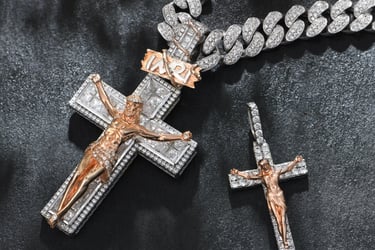
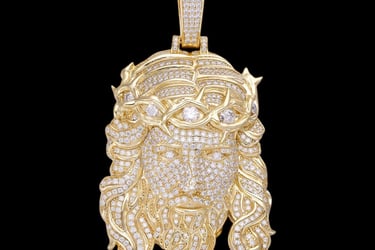
Lab Diamond Jesus Pendants: 2026 Faith Trend
2026 TRENDS
SHAMBH
1/2/20266 min read
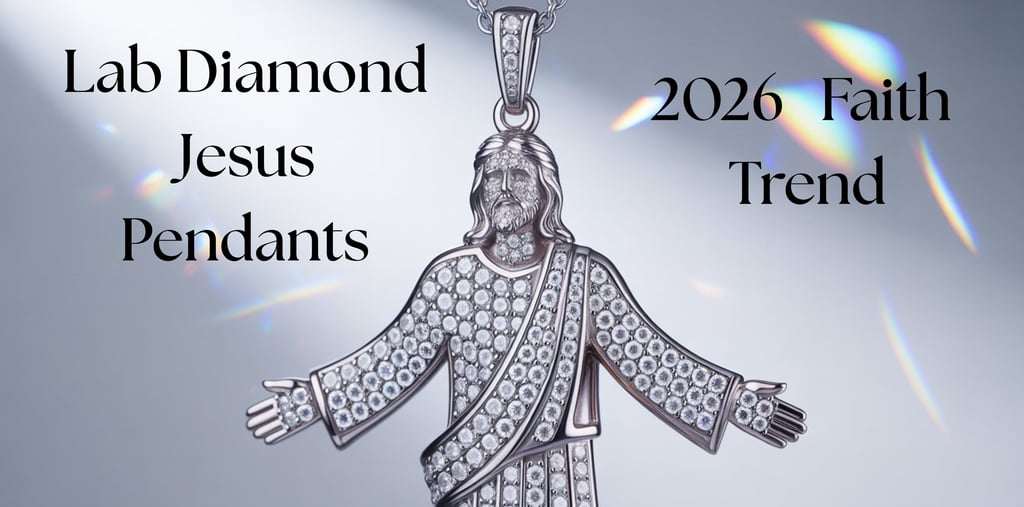
The jewelry industry is experiencing a significant shift, and lab diamond Jesus pendants are at the forefront of this transformation. As someone who's tracked jewelry market trends for over a decade, I've observed the lab-grown diamond sector grow from a niche market to a mainstream preference, with the global lab-grown diamond market projected to reach $37.32 billion by 2030, according to industry reports.
Faith-based jewelry has always held cultural significance, but in 2026, consumers are making purchasing decisions based on ethics, value, and quality. Lab diamond Jesus pendants satisfy all three criteria while maintaining the spiritual symbolism that makes religious jewelry meaningful.
Understanding Lab-Grown Diamonds: The Science Behind the Sparkle
Lab-grown diamonds are real diamonds—not simulants like cubic zirconia or moissanite. They're created using two primary methods: High Pressure High Temperature (HPHT) and Chemical Vapor Deposition (CVD). Both processes replicate the natural conditions that form diamonds beneath the Earth's surface, producing stones that are chemically, physically, and optically identical to mined diamonds.
According to the Federal Trade Commission, lab-grown diamonds have the same chemical composition (pure carbon in a crystalline structure) and score 10 on the Mohs hardness scale, just like natural diamonds. Even gemologists require specialized equipment to distinguish between lab-grown and mined diamonds because they're structurally identical.
This scientific equivalence is crucial for religious jewelry buyers. Your lab diamond Jesus pendant isn't a compromise—it's a genuine diamond with all the brilliance, fire, and durability of stones formed over millions of years underground.
The Cost Advantage: 40-70% Savings on Identical Quality
One of the most compelling reasons for the surge in lab diamond Jesus pendant popularity is straightforward economics. Lab-grown diamonds typically cost 40-70% less than comparable mined diamonds, according to industry pricing data from 2024-2025.
This price difference isn't due to inferior quality—it's the result of a more efficient production process. Mining operations involve extensive labor, heavy machinery, land acquisition, and multi-stage distribution networks. Laboratory production streamlines this process significantly, and those savings transfer directly to consumers.
For religious jewelry buyers, this means access to larger stones, better clarity grades, and more intricate designs. A one-carat lab diamond Jesus pendant with VS1 clarity that might cost $800-$1,200 could run $3,000-$4,000 with a mined diamond. The savings allow consumers to invest in heirloom-quality pieces without financial strain.
Ethical Production and Environmental Impact
The ethical considerations surrounding diamond sourcing have become increasingly important to consumers, particularly among Millennials and Gen Z who represent a growing portion of the jewelry market. A 2023 survey by MVI Marketing found that 70% of millennials would consider purchasing a lab-grown diamond.
Lab diamond Jesus pendants offer complete supply chain transparency. There's no ambiguity about origin, no concerns about funding conflicts, and no questions about labour conditions. The entire production process occurs in regulated facilities with documented practices.
Environmental impact is another measurable factor. While both mined and lab-grown diamonds require energy, the environmental footprint differs substantially. Diamond mining displaces approximately 250 tons of earth per carat, according to environmental studies. It also requires significant water resources and can disrupt local ecosystems. Lab-grown diamond production, while energy-intensive, is increasingly powered by renewable energy sources and doesn't involve large-scale land disruption.
For faith-based jewelry, these ethical considerations align with religious values of stewardship and social responsibility found across many traditions.
Market Growth and Consumer Trends in 2026
The numbers tell a clear story. The lab-grown diamond jewelry market has experienced double-digit growth annually since 2020. In 2026, lab-grown diamonds account for an estimated 15-20% of the overall diamond market, with projections suggesting this could reach 50% or more by 2030.
Religious jewelry represents a stable segment within the broader market. Jesus pendants, crosses, and other faith-based pieces have consistent demand driven by personal devotion, gifts for religious milestones (baptisms, confirmations, communions), and cultural traditions. The integration of lab-grown diamonds into this category makes luxury religious jewelry accessible to a broader demographic.
Retail data shows that consumers are particularly drawn to lab diamond jewelry in the $500-$2,000 range—a price point that offers substantial quality while remaining accessible for gift-giving and personal purchases. Lab diamond Jesus pendants fit perfectly into this sweet spot.
Quality and Craftsmanship Standards
Lab-grown diamonds are graded using the same standards as mined diamonds. The Gemological Institute of America (GIA), International Gemological Institute (IGI), and other certification bodies evaluate lab diamonds based on the traditional Four Cs: Cut, Clarity, Color, and Carat weight.
When purchasing a lab diamond Jesus pendant, you should expect the same documentation and certification you'd receive with any quality diamond jewelry. Reputable retailers provide grading reports that detail the diamond's characteristics, confirm its lab-grown origin, and verify the metal quality of the setting.
Modern jewelry craftsmanship has evolved to take advantage of the cost efficiencies of lab diamonds. Jewelers can create more intricate designs—micro-pavé settings, detailed sculptural work, and multi-stone arrangements—because the diamond cost allows for greater investment in the artistic elements.
The pendant itself benefits from precision manufacturing techniques. Three-dimensional modeling, laser cutting, and traditional hand-finishing combine to create pieces with exceptional detail. Whether you prefer classic representations or contemporary interpretations, the craftsmanship quality available in 2026 is remarkable.
Selecting Your Lab Diamond Jesus Pendant
When choosing a lab diamond Jesus pendant, apply the same criteria you would to any significant jewelry purchase. Consider the diamond quality first—cut determines brilliance, so prioritize excellent or ideal cut grades. Clarity and color should be eye-clean (VS2 or better is recommended) and near-colorless (G-H range or higher) for maximum visual appeal.
Size matters for visibility and impact. Smaller pendants (0.25-0.50 carats total diamond weight) offer subtle elegance, while larger pieces (0.75-1.5 carats or more) create statement jewelry suitable for special occasions.
Metal choice affects both aesthetics and durability. White gold and platinum complement the colorless nature of diamonds and suit modern tastes. Yellow gold offers traditional warmth and complements certain skin tones beautifully. Rose gold provides a contemporary option that's gained popularity in recent years.
Verify that your retailer provides proper certification for the lab diamonds and offers warranties covering manufacturing defects. Reputable sellers stand behind their products with return policies and service guarantees.
The Investment Perspective
Lab diamond Jesus pendants represent lasting value. The diamonds themselves are permanent—they won't degrade, cloud, or deteriorate over time. With basic care (periodic professional cleaning, proper storage), your pendant will maintain its beauty indefinitely.
While lab diamond jewelry isn't typically purchased as a financial investment like stocks or bonds, lab diamond pieces offer excellent value retention relative to their purchase price. As lab diamonds become increasingly accepted and preferred, the stigma that once affected their resale value has largely disappeared.
More importantly, the personal and spiritual value of a Jesus pendant transcends monetary considerations. These pieces serve as daily reminders of faith, family heirlooms passed through generations, and tangible connections to belief systems that provide meaning and comfort.
Why Now: The Perfect Convergence of Factors
The popularity surge of lab diamond Jesus pendants in 2026 isn't coincidental—it's the result of multiple factors aligning. Technology has matured, making lab diamond production reliable and scalable. Consumer awareness has grown through education and marketing. Ethical concerns have become mainstream rather than niche. And pricing has reached levels that make luxury religious jewelry accessible to middle-class consumers.
Additionally, the social acceptance of lab-grown diamonds has reached a tipping point. Major retailers, including some traditional jewelry houses, now offer lab-grown options. Celebrity endorsements and media coverage have normalized the choice. Younger consumers, who will drive jewelry purchases for decades, overwhelmingly view lab diamonds favourably.
For religious jewelry specifically, lab diamonds solve a unique challenge: how to honor faith through beautiful adornment while respecting values of ethical sourcing and responsible consumption. The lab diamond Jesus pendant answers this question elegantly.
The rising popularity of lab diamond jesus pendants reflects broader changes in how consumers approach luxury purchases. Today's jewelry buyers want quality, value, ethics, and meaning—and they're unwilling to compromise on any of these factors.
Lab-grown diamonds deliver on all counts. They're genuine diamonds with identical properties to mined stones, offered at significantly lower prices, produced ethically with transparent supply chains, and available in increasingly sophisticated designs. For religious jewelry, this combination creates pieces that honor faith while aligning with contemporary values.
As we progress through 2026 and beyond, the trend toward lab diamond jewelry will continue strengthening. The lab diamond Jesus pendant sits at the intersection of tradition and innovation—a meaningful choice for those who want their jewelry to reflect both their beliefs and their values. Whether you're purchasing for yourself or as a gift for someone special, you're choosing a piece that represents the best of modern jewelry craftsmanship combined with timeless spiritual significance.
Contact Shambh today to explore our extensive, certified collections of natural diamonds and lab grown diamonds, and secure the inventory that drives growth for your business.
Elegance
Discover our exquisite diamond jewelry collections today.
Get in Touch
Subscribe
support@shambh.com
+91 96012 68918
© Shambh 2025. All rights reserved.