Welcome to SHAMBH!

Lab Created Diamond Tennis Chain: Your Ultimate Style Statement in 2026
TRENDS
SHAMBH
2/27/202610 min read
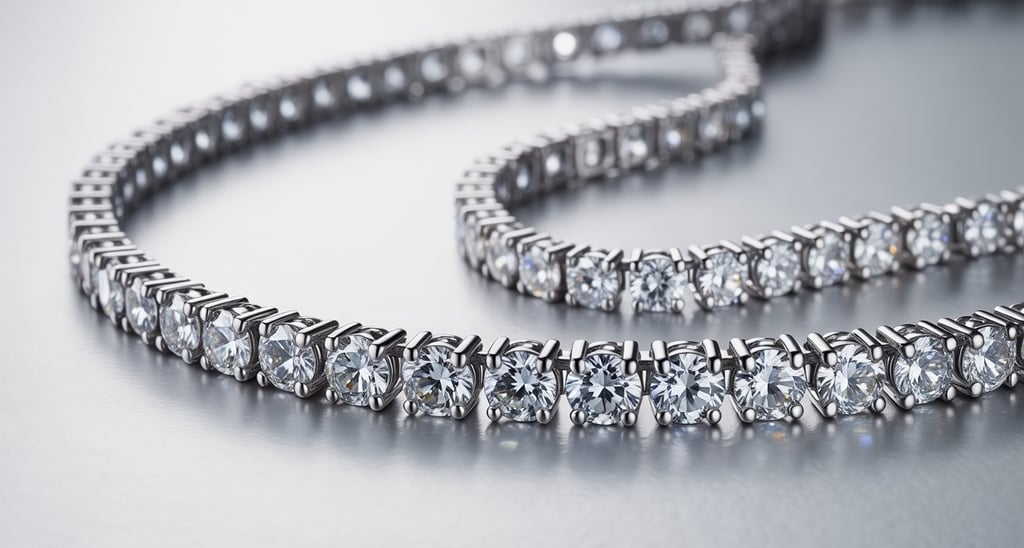
If there's one piece of jewelry that's absolutely everywhere right now, it's the tennis chain. I'm talking about everyone from your favorite Instagram influencers to that colleague who always looks effortlessly put together. But here's what makes 2026 different—lab created diamond tennis chains are changing the game completely. You get that same jaw-dropping sparkle, the same luxurious feel, but without the hefty price tag or ethical concerns that come with traditional mined diamonds.
Let me walk you through everything you need to know about these stunning pieces, because trust me, once you understand what makes them special, you'll wonder why everyone isn't wearing one.
What Exactly Is a Tennis Chain?
A continuous line of perfectly matched diamonds, each one catching the light as you move, creating this mesmerizing sparkle that runs all the way around your neck. That's a tennis chain. Unlike chunky statement necklaces or delicate pendant chains, tennis chains are all about that seamless diamond experience. Each stone is individually set in precious metal—usually 14K or 18K gold, sometimes silver—and they're connected in a way that makes the whole thing flexible and comfortable to wear.
Now, the name itself has a pretty cool backstory. Back in 1987, tennis legend Chris Evert was in the middle of a US Open match when her diamond bracelet snapped and fell off. She actually stopped the match to look for it (talk about priorities, right?). That moment was so memorable that people started calling these continuous diamond pieces "tennis bracelets," and eventually the style moved to necklaces too. What started as a sports moment became this iconic jewelry design that's stood the test of time. Today, you'll see tennis chains on red carpets, in hip-hop music videos, at weddings, and honestly, just walking down the street. They've gone from "special occasion only" to "wear it whenever you want to feel amazing."
The really exciting part? Lab-grown diamonds have made these pieces accessible to people who would've never been able to afford them before. According to GIA research, about 20% of all diamonds sold by 2025 are lab-grown, and that number keeps climbing. The US market saw a massive 43% jump in lab-grown diamond jewelry sales in 2024 alone. We're not talking about a small trend here—this is a fundamental shift in how people buy diamonds, and tennis chains are right at the center of it.
Understanding What Makes a Great Tennis Chain
When you're shopping for a tennis chain, you'll hear a lot about the 4Cs—Cut, Color, Clarity, and Carat. These aren't just fancy industry terms; they actually matter a lot, especially for tennis chains where you've got dozens of diamonds all sitting together. Here's the thing: each diamond needs to be cut precisely so they all sparkle the same way. Nothing kills the vibe faster than a tennis chain where some stones look dull while others are firing off light like crazy. That's why most quality tennis chains stick to excellent or very good cut grades across all the diamonds.
Color is another big deal, but maybe not in the way you'd think. You don't necessarily need the absolute most colorless grade (that's D color, and it's expensive). Most tennis chains use F or G color diamonds, which look completely colorless to your eye but cost significantly less than D or E. The key is consistency—all the diamonds should match each other. For clarity, you're usually looking at VS (Very Slightly Included) or better. Since you're wearing the chain at neck level and people aren't examining it with a magnifying glass like they might an engagement ring, VS clarity gives you that eye-clean look without paying for VVS or Flawless grades you honestly don't need.
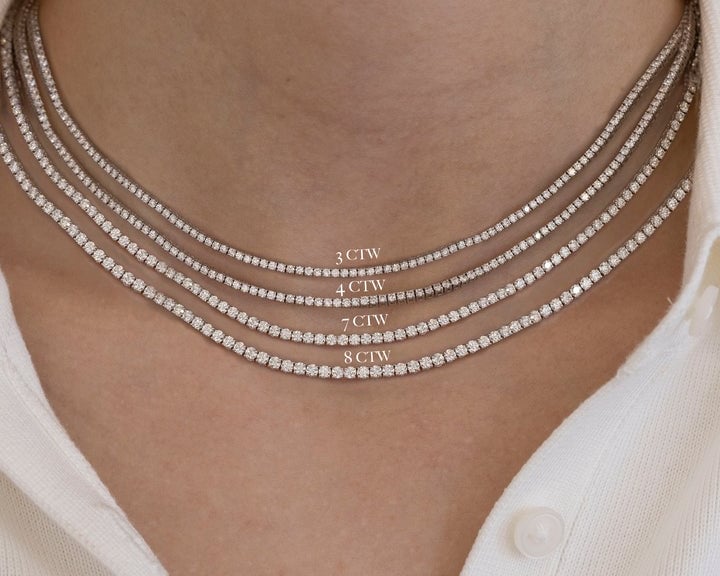
Now let's talk about what really impacts the look and price: total carat weight, or TCW. This is the combined weight of every single diamond in the chain. A tennis chain with 1-5 carats TCW gives you that subtle, everyday elegance—nice sparkle that enhances your outfit without overwhelming it. Jump to 5-10 carats TCW and you're in that sweet spot where the chain has real presence, perfect for special occasions but still wearable for confident daily styling. Go above 10 carats, maybe 15 or 20 carats TCW, and now you're making a serious statement. This is the territory where the chain becomes the focal point of your entire look.
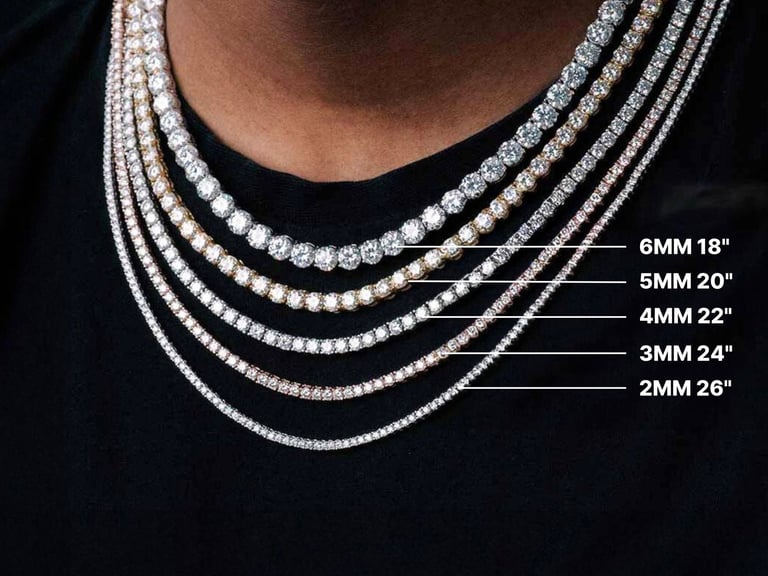
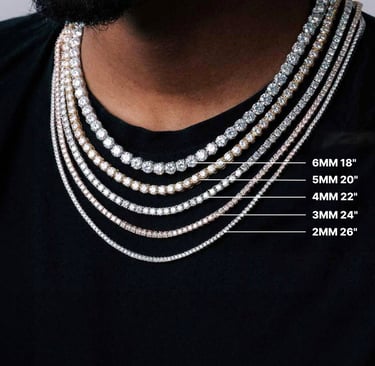
Length matters more than most people realize. The classic 16-18 inch length sits right at your collarbone, works for basically everyone, and layers beautifully with other necklaces. It's the most popular choice for women and there's a reason—it just works. The 20-22 inch length drops a bit lower, great if you like V-necks or want something that feels a little more relaxed. I'm seeing more men go for this length too. Then you've got your 24-30 inch chains, which are huge in hip-hop culture and streetwear. These longer styles are perfect for layering or if you just want that bold, attention-grabbing look.
Width is the other game-changer. A delicate 2mm chain with tiny 3-point diamonds is understated and feminine, perfect for everyday wear. Step up to 3mm with 6-point diamonds and you get more presence while still keeping it versatile—this is probably the most popular width because it works for everyone and every occasion. Go 4mm or wider and you're in statement territory, especially popular for men's jewelry and anyone who wants their tennis chain to be the main event.
Why Lab-Grown Makes So Much More Sense
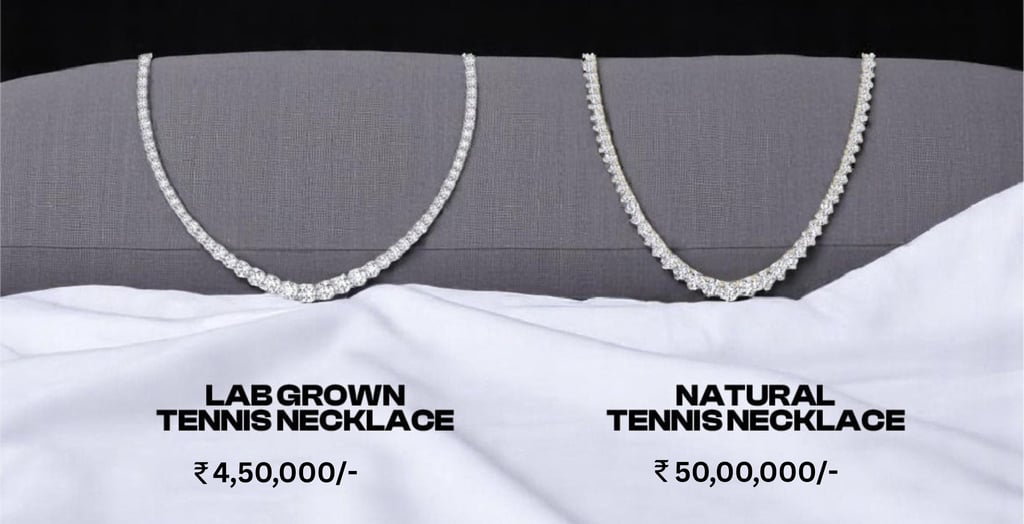
Let's talk money for a second, because this is where lab-grown diamonds absolutely shine. A 5-carat total weight tennis chain in 14K white gold with VS clarity and F-G color diamonds would run you somewhere between ₹4,50,000 to ₹9,00,000 if you're buying natural diamonds. That same exact chain—and I mean identical in every way that matters—costs about ₹90,000 to ₹2,25,000 in lab-grown diamonds. You're saving anywhere from ₹2,70,000 to ₹6,75,000. That's not a small discount; that's life-changing money for most people.
According to Indian market data, you're looking at ₹30,000-₹70,000 for a 1-carat lab-grown diamond depending on quality, and ₹60,000-₹1,20,000 for a 2-carat stone. When you're buying a tennis chain with multiple carats, those savings compound beautifully. You could either buy a modest natural diamond tennis chain, or you could get a seriously impressive lab-grown piece with the same money—maybe even upgrade the metal to 18K gold or platinum, increase the total carat weight, or buy matching earrings and a bracelet to complete the set.
Lab-grown diamonds aren't fake diamonds or diamond alternatives. They're real diamonds. Same hardness (10 on the Mohs scale—literally the hardest natural material on Earth), same chemical structure (pure carbon crystallized in the exact same way), same optical properties that create that signature diamond sparkle. The GIA and IGI—the most respected gemological institutes in the world—grade lab-grown diamonds using the exact same standards they use for natural diamonds. Put a lab-grown diamond and a natural diamond side by side, and even professional gemologists need specialized equipment to tell them apart. The only real difference is that one formed in the Earth's mantle billions of years ago, and the other was created in a laboratory over a few weeks. Everything else? Identical.
For a lot of people, especially younger buyers, the ethical side matters just as much as the savings. Every lab-grown diamond has complete transparency in its supply chain. You know exactly where it came from, how it was made, and that nobody was exploited in the process. Mining operations, even when done responsibly, involve massive environmental disruption—think huge excavations, water displacement, habitat destruction. Lab-grown diamond production happens in controlled facilities with measurable, manageable environmental footprints. It's not perfect (they do use energy), but it's dramatically better than ripping up the earth to find diamonds. If sustainability and ethical sourcing matter to you—and for more consumers in 2026, it absolutely does—lab-grown is the clear choice.
How to Actually Wear Your Tennis Chain
One of my favourite things about tennis chains is how ridiculously versatile they are. I've got clients who wear theirs to the gym, to board meetings, to weddings, and everything in between. In a professional setting, a simple white or yellow gold tennis chain adds just the right amount of polish to business attire. It looks intentional and put-together with button-downs and blazers, but it's not flashy or distracting. For everyday casual wear, throw it on with jeans and a t-shirt, and suddenly your whole outfit feels more elevated. It's that effortless elegance thing everyone's always chasing.
When you've got a special event—maybe a wedding or a formal dinner—a tennis chain with 7+ carats total weight becomes the star of your outfit. These pieces photograph incredibly well because they catch light from literally every angle. In every photo, you've got this continuous sparkle framing your face. And if you're into streetwear or hip-hop fashion, longer 24-30 inch chains in yellow or rose gold have become absolute staples, often layered with other chains for that bold, personalized aesthetic.
Metal choice changes the whole vibe of the piece. White gold is sleek and modern—it blends with the diamonds to create this bright, contemporary look that feels current and sophisticated. Yellow gold brings warmth and that classic luxury feel; it's having a major moment right now as vintage-inspired styles come back strong. Rose gold sits somewhere in between—it's romantic and distinctive without being too trendy. And if you want the absolute premium option, 18K gold or silver won't need re-plating like white gold sometimes does, if you have sensitive skin.
Don't be afraid to layer your tennis chain either. Mix different lengths—maybe your tennis chain at 16 inches with a plain gold chain at 18 inches and a pendant at 20 inches. The current trend is actually mixing metals too, so your white gold tennis chain can absolutely sit alongside yellow gold pieces. Sometimes though, the best approach is just wearing a substantial tennis chain by itself and letting it be the statement.
What to Look for When You're Buying
When you're ready to buy, start with certification. Your diamonds should come with documentation from IGI or GIA confirming they're lab-grown, along with all the quality details. Check that every diamond is securely set—most tennis chains use either four-prong or bezel settings, and you want to make sure each stone is firmly held in place. The clasp needs to be rock solid too, usually a box clasp with a safety latch. This is the most vulnerable part of any chain, so don't skimp here.
Make sure all the diamonds match each other in color, clarity, and size. Nothing looks worse than a tennis chain where you can see visible differences between stones. And verify the metal quality with proper hallmarks—"14K" or "18K" stamps that confirm you're getting what you paid for. A quality tennis chain has some weight to it; if it feels too light, that's a red flag.
Budget-wise, you've got options at every price point. Entry level pieces from ₹90,000 to ₹2,25,000 get you 2-5 carats TCW in 14K gold—perfect if you're trying the style for the first time or want something for everyday wear. Mid-range from ₹2,25,000 to ₹4,50,000 steps up to 5-10 carats TCW with better metal options, giving you that excellent quality-to-value ratio. Premium pieces from ₹4,50,000 and up feature 10-20+ carats in 18K gold or silver—these are serious investment pieces that become family heirlooms.
Here's a pro tip: the jump from 5 carats to 7 carats makes a huge visual difference but doesn't cost proportionally more per carat. If you're on the fence between sizes, consider going slightly larger for better overall value and impact.
Taking Care of Your Diamond
Tennis chains are pretty low-maintenance, but a little care goes a long way. Clean yours weekly with warm water, mild soap, and a soft brush—this keeps oils and lotions from building up and dulling the sparkle. Take it off before you swim (chlorine is harsh on metal settings), before applying perfume or hairspray (chemical residue is diamond's enemy), and definitely before hitting the gym or doing anything physically intense. Store it separately in a fabric-lined jewelry box so it doesn't scratch other pieces.
Once a year, take it to a jeweler for professional inspection and ultrasonic cleaning. They'll check for loose prongs or worn settings before small problems become big ones. Sometimes prongs need tightening—it's a simple service that costs around ₹2,000-₹5,000 and prevents you from losing diamonds. If your chain is worth over ₹1,00,000, seriously consider adding it to your insurance. It's one of those things you hope you never need, but you'll be grateful to have if something happens.
Why SHAMBH Gets It Right
At SHAMBH, we're based in Surat, Gujarat—the city that processes 90% of the world's diamonds. That's not just a fun fact; it means we've got direct access to the best lab-grown diamond producers and the most skilled artisans in the industry. Our craftspeople are third-generation diamond setters whose families have been perfecting this work for decades. When you buy a tennis chain from us, you're getting that combination of cutting-edge lab-grown technology and old-world craftsmanship that's pretty hard to find elsewhere.
Every single diamond comes certified by IGI or GIA, so you know exactly what you're getting. We don't do hidden markups or confusing pricing—you see exactly what you're paying for in terms of diamonds, metal, and craftsmanship. And if you don't see exactly what you want in our collection, our design team will work with you to create something custom. We're not here to push you into buying something you don't love; we want you to understand what makes a great tennis chain so you can make the choice that's right for you.
Look, lab-grown diamond tennis chains represent something bigger than just another jewelry trend. They're about making luxury accessible, choosing ethical sourcing, and getting incredible beauty without compromise. Whether you're treating yourself to your first tennis chain, upgrading from a smaller piece, or finding the perfect gift, there's never been a better time to explore these stunning pieces.
Ready to see what we're talking about?
Schedule a consultation, or let's design something custom that's uniquely yours. Your perfect tennis chain is waiting.
Quick Note on Pricing: The prices I've mentioned are estimates based on current market conditions and can vary depending on exact specifications, quality grades, and market fluctuations. For precise pricing on specific pieces, reach out to us directly—we'll give you accurate numbers for exactly what you're looking for.
Elegance
Discover our exquisite diamond jewelry collections today.
Get in Touch
Subscribe
support@shambh.com
+91 96012 68918
© Shambh 2025. All rights reserved.